
What Is HVAC SEO?
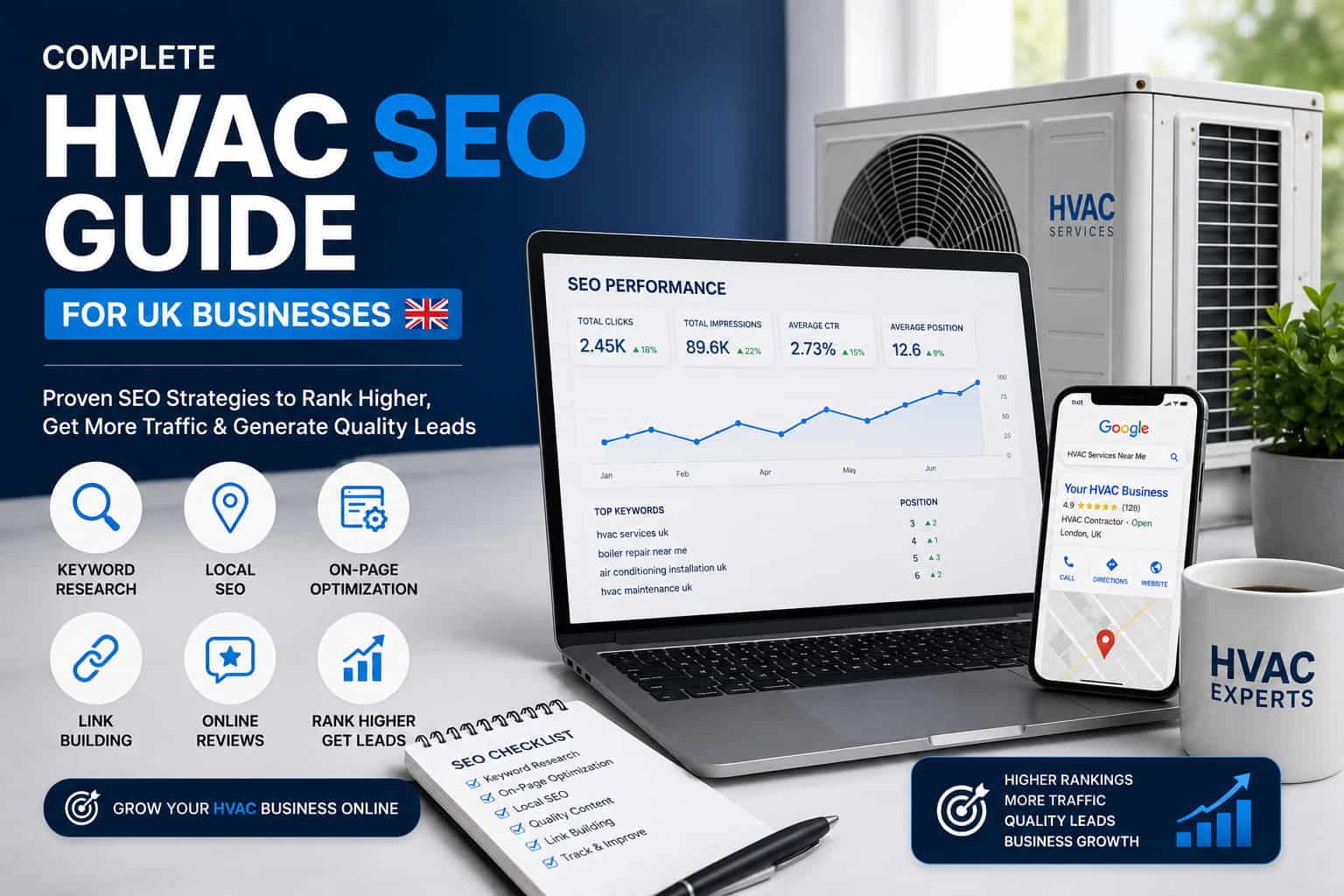
HVAC SEO (Search Engine Optimization) is the process of improving your heating, ventilation, and air conditioning business’s visibility on search engines like Google so that when a local homeowner or landlord types in something like “boiler repair near me” or “gas engineer Birmingham”, your business appears at the top of the results instead of a competitor’s.
Think of it this way: Google is essentially the world’s biggest referral network. Every day, millions of UK residents turn to Google to find trusted local tradespeople. HVAC SEO is the art and science of making sure Google recommends your business first.
Simple Definition
HVAC SEO = making your business easy for Google to find, understand, and recommend to the right customers at the right time. It’s not about tricking Google; it’s about making your website and online presence genuinely useful, trustworthy, and locally relevant.
Unlike paid advertising (Google Ads, Facebook Ads), SEO doesn’t require you to pay for every click. Once you’ve earned a high ranking, you receive free, ongoing traffic from people actively searching for exactly what you offer. For HVAC companies, this typically means enquiries about:
- Boiler installation, repair, and annual servicing
- Emergency heating breakdowns
- Gas safety certificates (CP12) for landlords
- Air conditioning installation and servicing
- Heat pump installation (growing rapidly in 2025 due to UK government grants)
- Power flushing and central heating system maintenance
- Underfloor heating installation
HVAC SEO is not a single action; it’s a collection of ongoing strategies across your website, your Google Business Profile, online reviews, and your general digital presence. When all these elements work together, the result is a steady, predictable flow of new customer enquiries.
How Does HVAC SEO Work?
To understand how HVAC SEO works, you first need to understand how Google decides which businesses to show at the top of search results. Google uses automated programs called “crawlers” or “spiders” that constantly browse the internet, reading websites and cataloguing their content. Based on hundreds of ranking signals, Google then ranks websites in order of relevance and trustworthiness for any given search query.
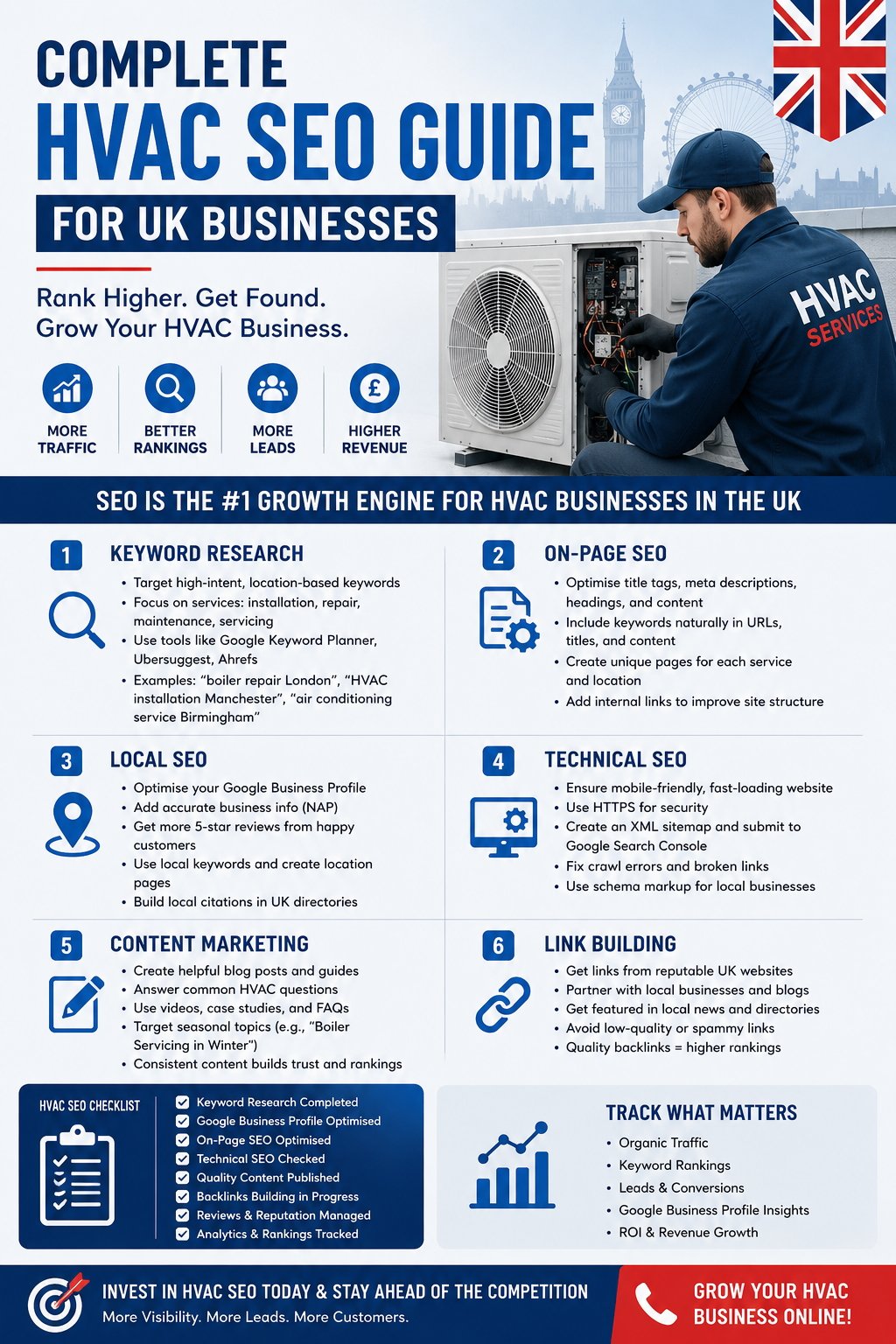
HVAC SEO works by optimizing the signals Google looks for across four main areas:
1. Keywords & Content
Google reads your website to understand what services you offer and where. Using the right keywords (the exact phrases customers type) throughout your website tells Google exactly what you do.
2. Local Signals
Your Google Business Profile, local citations (directory listings), and location-specific web pages tell Google where your business operates, so it shows you to nearby searchers.
3. Authority & Trust
When other reputable websites link to yours (backlinks), Google treats it as a vote of confidence. Reviews, Gas Safe registration, and trade accreditations also build trust signals.
4. Technical Performance
Google rewards websites that load fast, work perfectly on mobile, and are easy to navigate. A slow or broken website will rank below a technically sound competitor even with better content.
The HVAC SEO Process Step by Step
1A Customer Has a Problem
A homeowner in Leeds woke up to a broken boiler in January. Their first instinct is to reach for their phone and search Google for “emergency boiler repair Leeds”.
2Google Scans Its Index
In milliseconds, Google searches its entire index of websites and Google Business Profiles to find the most relevant, trustworthy, and nearby HVAC businesses for that query.
3Your Optimized Business Appears
Because you’ve optimized your website and GBP for “emergency boiler repair Leeds”, your business appears in the top 3 results both in the map pack and organic results.
4The Customer Clicks, Calls, Books
They see your 50+ Google reviews, your Gas Safe badge, and your clear pricing. They call you. You get the job without spending a penny on advertising.
5The Cycle Compounds
You complete the job, request a review, add photos to your GBP, and publish a follow-up blog post. Each action strengthens your SEO further, making the next job even easier to win.
“SEO is not something you do once and forget. It’s a living system. The more you feed it with great content, reviews, and local signals, the more it rewards you with free, consistent customer enquiries.”
Why Do You Need HVAC SEO?
You might be wondering: “I already get jobs through word of mouth and Checkatrade, do I really need SEO?” The honest answer is: if you want predictable, scalable growth that doesn’t depend on referrals or paid advertising, then yes, HVAC SEO is not optional, it’s essential.
Here are the most compelling reasons why HVAC businesses across the UK are investing in SEO right now:
It’s the Lowest Long-Term Cost Per Lead
Google Ads for HVAC keywords can cost £10–£30 per click in competitive UK cities. With SEO, once you rank, each visitor costs you nothing. A single well-ranked page can generate hundreds of free leads per year.
Customers Are Searching Right Now
Unlike social media, where you interrupt someone’s scroll, SEO puts you in front of people who are actively looking for a heating engineer at that exact moment. This intent-driven traffic converts far better than any other channel.
Your Competitors Are Already Doing It
The HVAC businesses dominating the first page of Google in your area didn’t get there by accident; they invested in SEO. Every month you delay, they pull further ahead. The best time to start is now.
SEO Results Compound Over Time
Unlike ads that vanish the moment you stop paying, SEO builds a permanent asset. A blog post written today can rank and generate leads for 3 to 5 years. Your website becomes more valuable every month.
Mobile & Voice Search Is Exploding
Over 70% of HVAC searches in the UK now happen on mobile devices. Voice searches like “Hey Google, find a boiler engineer near me” are growing rapidly. SEO ensures your business captures this modern search behavior.
It Builds Lasting Trust and Credibility
Customers trust Google. When your business ranks at the top, it carries an implicit endorsement. Combined with reviews, accreditations, and a professional website, SEO transforms how potential customers perceive your business.
It’s Fully Measurable
Every call, form submission, and website visit from SEO can be tracked using free tools like Google Analytics and Google Search Console. You know exactly what’s working and can invest more in what drives results. 🇬🇧
UK-Specific Opportunities Are Growing
The UK government’s Boiler Upgrade Scheme, heat pump grants, and net-zero housing targets are driving a surge in searches for green heating solutions. HVAC businesses that position themselves now for heat pump and renewable energy searches will dominate the next decade.
£85 billion The estimated size of the UK heating and plumbing market by 2030 — and the businesses that rank on Google will capture the lion’s share of that growth.
Why SEO Matters for HVAC Businesses in the UK
The UK HVAC and plumbing market is intensely competitive. Homeowners and property managers no longer flip through the Yellow Pages; they pull out their phone, type “boiler service near me” or “emergency heating engineer London,“ and click one of the first three results. If your business isn’t there, a competitor gets the job.
HVAC SEO UK Key Statistics
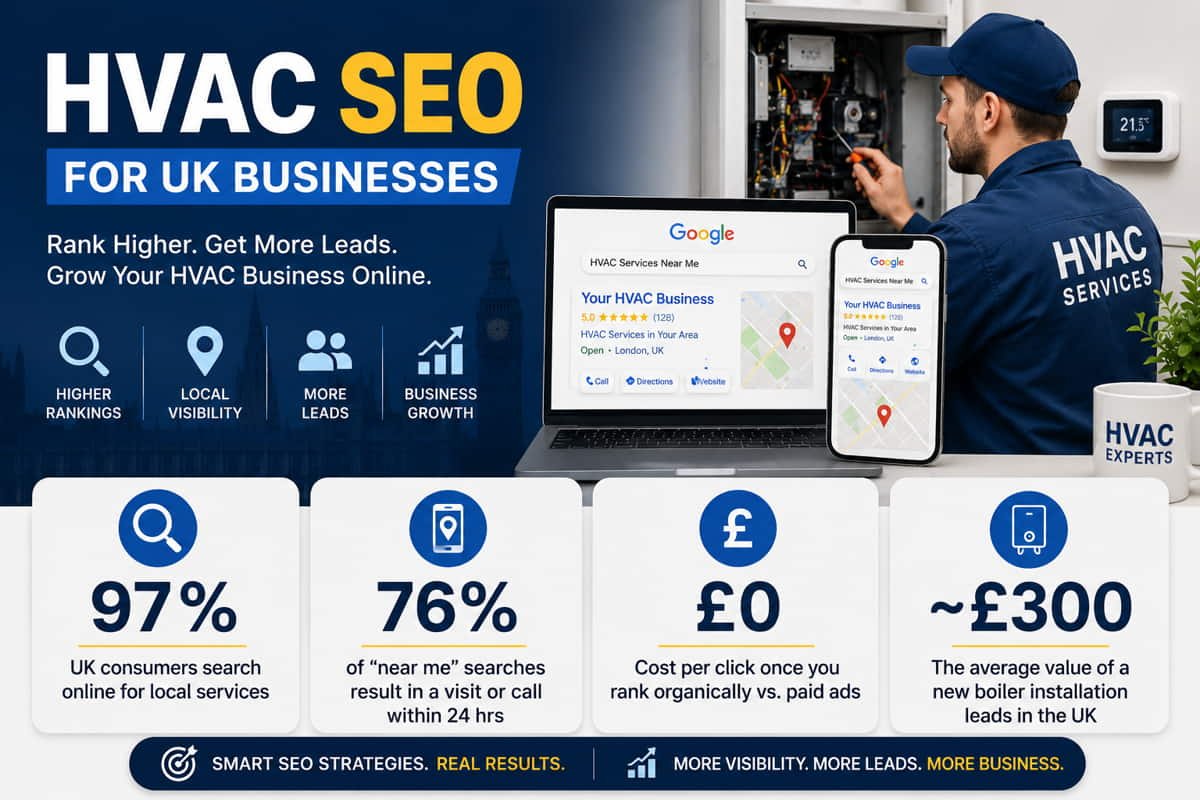
| Metric | Value | Description |
|---|---|---|
| Online Search Behavior | 97% | UK consumers search online for local services |
| Local Intent Conversions | 76% | “Near me” searches result in a visit or call within 24 hours |
| Organic Traffic Cost | £0 | Cost per click once you rank organically (vs. paid ads) |
| Lead Value | ~£300 | Average value of a new boiler installation lead in the UK |
Unlike Google Ads, which stops the moment you stop paying, SEO builds cumulative, compounding value. A well-optimized website and Google Business Profile can continue to generate enquiries for years. For trades businesses with tight margins, this is transformative.
Key Insight
The top 3 Google results capture roughly 75% of all clicks for a given search query. HVAC businesses in positions 4–10 share the remaining 25%. Positions beyond page 1 receive less than 1% of traffic combined. Your goal is to break into the top 3 for your key local terms.
HVAC Keyword Research for the UK Market
UK homeowners use a different language from their American counterparts. They search for boilers, not furnaces. They want a heating engineer, not an HVAC contractor. Your keyword strategy must reflect British terminology, regional variation, and search intent.
Types of Keywords to Target
Think in three buckets: commercial intent (ready to book), informational (researching), and local modifiers (location-specific).
| Keyword Example | Intent | Est. Monthly Searches | Competition |
| boiler installation [city] | Commercial | 500–2,000 | High |
| emergency heating engineer near me | Commercial | 1,000–5,000 | High |
| Boiler Service Cost UK 2025 | Informational | 2,000–8,000 | Medium |
| How often should a boiler be serviced | Informational | 1,500–4,000 | Low |
| air conditioning installation [city] | Commercial | 300–1,200 | Medium |
| landlord gas safety certificate [city] | Commercial | 400–1,500 | Medium |
| heat pump grant UK 2025 | Informational | 5,000–20,000 | Medium |
| Combi boiler vs system boiler | Informational | 3,000–10,000 | Low |
UK Specific Keyword Terminology
Always use the British spelling and terminology your customers actually use:
- Boiler (not furnace or water heater)
- Central heating (not space heating)
- Gas engineer/heating engineer (not HVAC technician)
- Radiator (not baseboard heater)
- Power flush (not chemical clean)
- Gas Safe registered (critical trust signal, always mention it)
- Landlord gas safety certificate / CP12
- Heat pump (growing rapidly due to Boiler Upgrade Scheme)
Free Keyword Tools to Use
Google Search Console (shows what you already rank for), Google Keyword Planner (free with Google Ads account), Ubersuggest, AnswerThePublic (great for question-based content ideas), and Google’s autocomplete. Just start typing HVAC queries and note the suggestions.
Long-Tail Keywords: Your Hidden Goldmine
Shorter keywords like “boiler repair” are dominated by national comparison sites (Checkatrade, Which?, Boiler Guide). The smarter play is to target long-tail keywords, longer, more specific phrases with lower competition and higher conversion intent:
- “Worcester Bosch boiler installation Birmingham.”
- “No hot water, but heating works. What to check?”
- “Vaillant boiler losing pressure fix.”
- “air source heat pump installation cost Scotland.”
- “Landlord gas safety certificate same day Leeds.”
Local SEO: Your Most Powerful Tool
For HVAC businesses, local SEO is the single highest-ROI marketing channel available. You’re not competing with HVAC companies in Edinburgh if you’re based in Bristol. Local SEO lets you dominate a defined geographical area and own it completely.
The Local SEO Trinity
Google’s local ranking algorithm considers three core factors commonly called the Local SEO Trinity:
Proximity
How close is your business to the searcher? You can’t control this, but you can ensure your service area pages target multiple towns and postcodes within your radius.
Relevance
How well do your Google Business Profile and website match what the user is searching for? Nail this with precise categories, keyword-rich descriptions, and dedicated service pages.
Prominence
How well-known and trusted is your business online? Reviews, citations, links from local websites, and your overall online footprint all drive this.
Create Location-Specific Service Pages
If you cover multiple towns, create a dedicated page for each service in each location. Don’t just duplicate content, write genuinely useful, locally relevant copy. For example:
- /boiler-installation-manchester/
- /boiler-installation-salford/
- /boiler-service-stockport/
- /emergency-heating-engineer-trafford/
Warning: Avoid Thin Location Pages
Google penalizes pages that are near-identical copies with just the town name swapped. Each location page should include: local landmarks or references, specific testimonials from that area, local knowledge about housing stock (e.g., “Many Victorian terraces in Salford still use older back boilers…”), and unique FAQs for that area.
Build Local Citations
A citation is any online mention of your business name, address, and phone number (NAP). Consistent citations across directories signal trust to Google. Priority UK directories for HVAC businesses:
- Yell.com
- Checkatrade
- TrustATrader
- MyBuilder
- Thomson Local
- Bing Places
- Apple Maps Connect
- Gas Safe Register (essential builds trust and links)
- NICEIC / OFTEC (if applicable)
- Your local council’s business directory
Critical: Your NAP must be 100% identical everywhere. “10 High St” and “10 High Street” are different from Google’s crawler.
Google Business Profile Optimization
Your Google Business Profile (GBP), the card that appears on the right side of Google search results and in Google Maps, is your single most important local SEO asset. Many HVAC businesses win jobs purely through their GBP without even ranking on their own website.
GBP Optimization Checklist
- Claim and verify your business via Google
- Choose the most accurate primary category (e.g., “Heating Contractor”, “HVAC Contractor”, “Plumber”)
- Add all relevant secondary categories
- Write a keyword-rich business description (750 characters), including your key services and towns served
- Add all your services with individual descriptions and prices where applicable
- Upload at minimum 20 high-quality photos (van, team, before/after installs, Gas Safe card)
- Set precise opening hours, including emergency/out-of-hours availability
- Add your website URL, phone number, and booking link
- Enable messaging so customers can text you directly
- Post weekly GBP updates (completed jobs, seasonal offers, tips)
- Respond to every review, positive and negative
- Add your service area (list all postcodes and towns you cover)
Pro Tip: GBP Posts
Treat your Google Business Profile like a social media feed. Post at least once per week. Share completed installations with photos, seasonal boiler-check reminders (September/October is peak), Government scheme updates (Boiler Upgrade Scheme), and any promotions. Posts keep your profile fresh and signal to Google that you’re an active, engaged business.
How to Handle Negative Reviews
Negative reviews are inevitable. How you respond matters enormously both to Google’s algorithm and to future customers reading your profile:
- Respond promptly (within 24 hours)
- Thank them for their feedback
- Acknowledge their concern without admitting liability
- Offer to resolve the issue offline (provide phone/email)
- Keep your tone professional and calm, never defensive
A well-handled negative review often reassures potential customers more than a page of five-star reviews.
On-Page SEO Best Practices
On-page SEO means optimizing the content and structure of each webpage to rank for target keywords. For HVAC businesses, this primarily means your homepage, service pages, and location pages.
Page Title & Meta Description
Every page needs a unique, keyword-optimized title tag and meta description:
- Title tag: 50–60 characters. Include primary keyword + location. Example: “Boiler Installation Manchester | Gas Safe Engineers | YourCo”
- Meta description: 150–160 characters. Include keywords, a benefit, and a call to action. Example: “Expert boiler installation across Manchester. Gas Safe registered engineers, 10-year warranty options. Call for a free quote today.”
Heading Structure (H1–H6)
- Use one H1 per page for your primary keyword phrase
- Use H2s for main sections (include secondary keywords naturally)
- Use H3s for sub-sections
- Never skip heading levels
Key On-Page Elements
- Primary keyword in first 100 words of body copy
- Natural use of LSI (related) keywords throughout, e.g., “Gas Safe”, “annual service”, “central heating.”
- Internal links to related service pages and location pages
- At least one image with a descriptive, keyword-rich alt tag
- Clear click-to-call phone number at top of every page (especially mobile)
- A clear call-to-action: “Get a Free Quote”, “Call Now,” “Book Online.”
- Trust signals: Gas Safe registration number, Trustpilot rating, years of experience, accreditations
- The FAQ section using H3 tags is excellent for featured snippets and voice search
- Schema markup: LocalBusiness, Service, FAQPage, Review
“Your homepage should answer three questions instantly: What do you do? Where do you do it? Why should I trust you? If a visitor can’t answer those within 5 seconds, you’re losing business.”
Content Marketing for HVAC Companies
A blog or resource section on your website is one of the most powerful long-term SEO tools available. It lets you rank for hundreds of informational keywords, build authority, answer customer questions before they even call, and earn links from other websites.
High-Value Blog Post Ideas for UK HVAC Businesses
- “How Much Does a New Boiler Cost in the UK? (2025 Guide)”
- “Combi Boiler vs System Boiler vs Heat-Only: Which Is Right for Your Home?”
- “What Is the Boiler Upgrade Scheme and Am I Eligible?”
- “10 Signs Your Boiler Needs Replacing.”
- “How to Bleed a Radiator: Step-by-Step Guide.”
- “Air Source Heat Pump vs Gas Boiler: Honest Comparison for UK Homes.”
- “How Often Should I Get My Boiler Serviced?”
- “What Is a Power Flush and Does My Central Heating Need One?”
- “Emergency Heating Breakdown: What to Do Before Calling an Engineer.”
- “Landlord Responsibilities for Gas Safety: A Complete UK Guide.”
Content That Converts
Not all content is equal. Focus on content that builds trust and drives enquiries:
Case Studies & Project Showcases
Document real installations with before/after photos, the challenge faced, the solution provided, and the customer outcome. These are powerful trust-builders and rank for brand and location terms.
Pricing Guides
UK customers almost always Google the cost before calling. Transparent pricing guides (“How much does a boiler service cost in 2025?”) rank incredibly well and pre-qualify leads.
Seasonal Content
Publish boiler-check reminders in August/September, heat pump grant updates in spring, and air conditioning guides in early summer. Align content with when customers are searching.
FAQ Pages
Use schema markup on FAQ sections to appear in Google’s rich results. Target question-based queries like “why is my boiler making a banging noise?” have extremely high intent.
Technical SEO Essentials
Technical SEO ensures Google can crawl, index, and understand your website. Many HVAC businesses have good content, but invisible technical issues are holding them back.
- Page speed: Your site must load in under 3 seconds on mobile. Test with Google PageSpeed Insights. Compress images, enable caching, and use a fast host (SiteGround, Cloudways, or Kinsta recommended for UK businesses)
- Mobile-first design: Over 70% of local HVAC searches happen on mobile. Your site must be flawless on a phone, especially the phone number (click-to-call) and quote forms
- HTTPS / SSL certificate: Non-negotiable. Google flags HTTP sites as “not secure” and ranks them lower
- XML sitemap: Submit to Google Search Console so all pages are indexed
- Robots.txt: Ensure it’s not accidentally blocking key pages from being crawled
- Core Web Vitals: LCP (loading), FID (interactivity), CLS (visual stability) check in Search Console and resolve any “Poor” flagged URLs
- Structured data / Schema: Add LocalBusiness, Service, FAQPage, and Review schema to relevant pages
- Fix broken links (404 errors): Crawl your site monthly with Screaming Frog (free up to 500 URLs) and fix or redirect broken pages
- Canonical tags: Prevent duplicate content issues across location pages
Mobile Speed Is Critical
A 1-second delay in mobile page load time reduces conversion rates by up to 20%. For an HVAC business getting 300 monthly website visitors, that could be 60 lost enquiries. Priorities speed above all other technical factors.
Link Building Strategies That Actually Work
Backlinks from other websites linking to yours remain one of Google’s top ranking signals. For HVAC businesses, the focus should be on local, relevant, and authoritative links rather than chasing volume.
Practical Link Building for UK HVAC Companies
- Gas Safe Register profile: Ensure your business appears in their contractor search. This is an authoritative government-backed domain link
- Trade association memberships: APHC, NICEIC, OFTEC, Trustmark, and MCS all provide directory listings with backlinks
- Local business partnerships: Partner with estate agents, letting agents, and property managers who can recommend you and link to your site
- Supplier relationships: If you’re an approved installer for Worcester Bosch, Vaillant, or Viessmann, request a listing on their “find an installer” pages. These are high-authority links
- Local press: Offer expertise to local newspapers or online news sites on topics like heat pump grants, energy efficiency, or rising energy bills
- Sponsor local events or sports teams: Local club websites often link to sponsors; these are genuine local links
- Guest posts on property or home improvement blogs: Write genuinely useful content about heating and HVAC topics
Online Reviews & Reputation Management
Reviews are the social proof that converts a Google search into a booked job. They also directly influence your local search rankings. For HVAC businesses, a consistent flow of 5-star reviews is as important as any technical SEO strategy.
How to Systemize Review Generation
Ask at the Right Moment
The best time to ask for a review is immediately after the job is complete and the customer has expressed satisfaction. This is when sentiment is highest.
Make It Frictionless
Send a personalized SMS or WhatsApp message with a direct link to your Google review page. The fewer clicks, the higher your conversion rate. Most review management tools can automate this.
Diversify Review Platforms
Google reviews are the priority, but also build up Trustpilot, Checkatrade, and TrustATrader. Each platform lends credibility to different audiences.
Respond to Every Review
Thank every reviewer personally. For 5-star reviews, mention the specific service (“Thank you for choosing us for your Worcester Bosch installation in Didsbury!”). This adds keyword-rich content to your profile.
Target: 50+ Google Reviews at 4.7+
Research suggests businesses with 50+ reviews and an average rating above 4.7 significantly outperform competitors in both click-through rates and conversion. Make this a 6-month milestone if you’re starting from scratch.
Measuring Your SEO Success
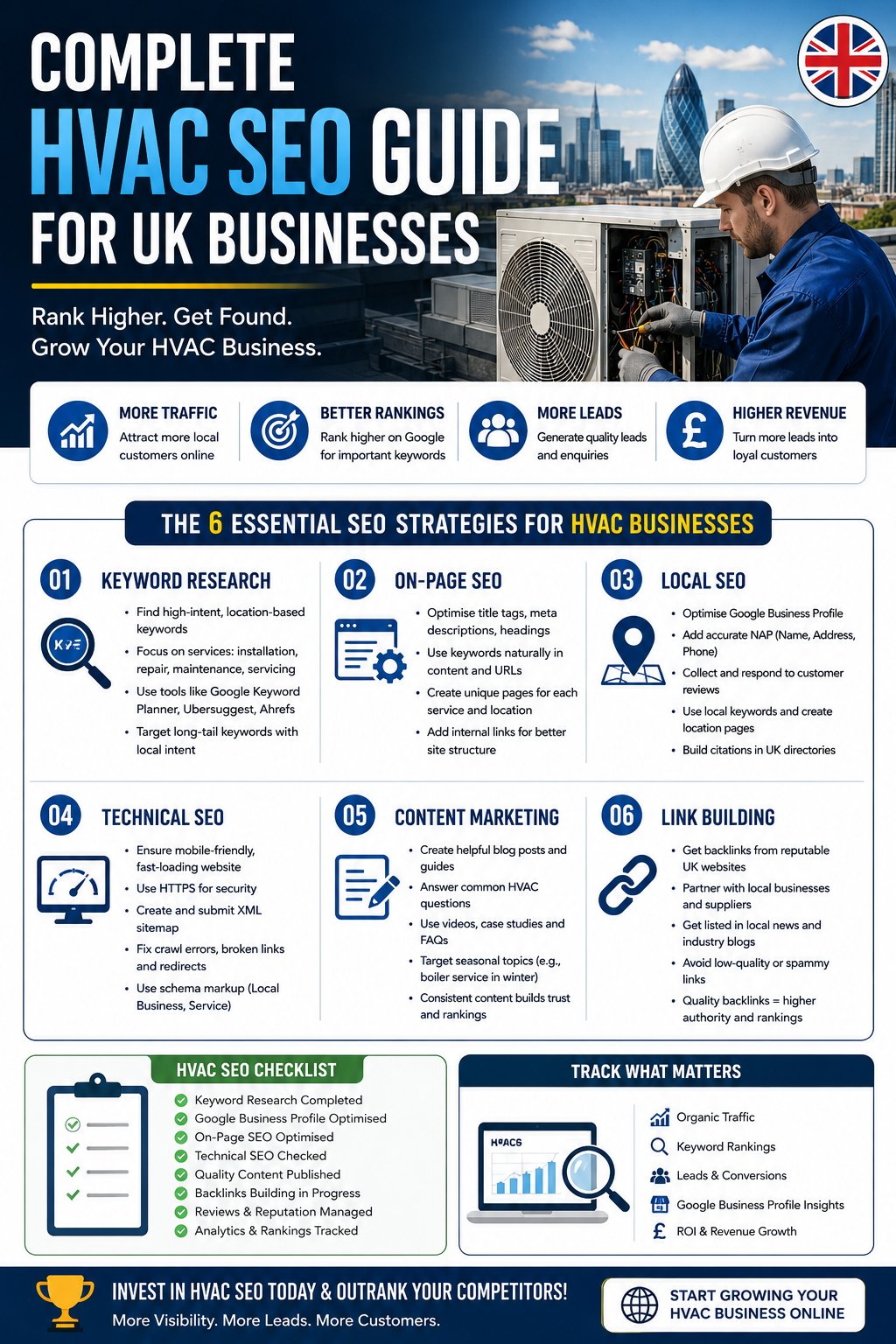
SEO without measurement is guesswork. Track the right metrics monthly to understand what’s working and where to focus your effort.
Essential KPIs for HVAC SEO
| Metric | Tool | Why It Matters |
| Organic traffic | Google Analytics 4 | Overall measure of SEO growth |
| Keyword rankings | Google Search Console / Semrush | Track progress for target keywords |
| GBP impressions & calls | Google Business Profile Insights | Direct measure of local visibility |
| Phone call conversions | CallRail / Google Tag Manager | Ties SEO activity to real revenue |
| Form submission conversions | Google Analytics 4 Goals | Measures website lead generation |
| Backlink growth | Ahrefs / Semrush / Moz | Tracks domain authority building |
| Core Web Vitals pass rate | Google Search Console | Technical health signal |
| Review count & rating | Manual/reputation tools | Trust & local ranking signal |
Realistic SEO Timelines
Set realistic expectations with your team or clients:
- 0–3 months: Technical fixes, GBP optimization, citation building. Little visible ranking movement, but critical groundwork.
- 3–6 months: Early ranking improvements for long-tail and local keywords. Organic traffic begins to tick up.
- 6–12 months: Meaningful ranking gains for competitive terms. Consistent lead flow from organic. Reviews accumulating.
- 12–24 months: Market dominance in your local area for core keywords. SEO becomes your primary lead generation channel.
Beware of “Quick Win” SEO Agencies
Any agency promising page 1 rankings in 30 days is lying or worse, using black-hat tactics that will eventually result in a Google penalty. Sustainable HVAC SEO is a 6–18 month investment. Choose agencies that show you their process, report transparently, and can demonstrate results from similar trade businesses.
Frequently Asked Questions
Q1. How long does HVAC SEO take to show results?
A. Most UK HVAC businesses start seeing early improvements within 3–6 months, especially for local and long-tail keywords like “boiler repair Stockport” or “Gas Safe engineer Leeds.” Competitive searches in larger cities can take 6 to 12 months or longer. SEO is a long-term investment, but once rankings improve, the leads become far more sustainable and cost-effective than paid advertising.
Q2. How much does HVAC SEO cost in the UK?
A. HVAC SEO pricing in the UK typically ranges from £500 to £3,000+ per month depending on your location, competition level, and the scope of work. Smaller local campaigns may focus on Google Business Profile optimization and local SEO, while larger companies often invest in technical SEO, content marketing, and ongoing link building to dominate multiple service areas.
Q3. Is SEO better than Google Ads for HVAC businesses?
A. SEO and Google Ads work best together, but SEO usually delivers the strongest long-term ROI. Google Ads can generate leads immediately, but traffic stops the moment you stop paying. SEO takes longer to build, yet it creates a lasting source of free, organic enquiries that continue generating leads month after month.
Q4. What is the most important SEO action for a new HVAC business?
A. For a new HVAC company, the biggest priority is optimizing your Google Business Profile and collecting genuine customer reviews. A fully completed GBP with accurate services, photos, service areas, and 5-star reviews can help you appear in Google Maps quickly even before your website gains strong rankings.
Q5. Should HVAC companies create blog content regularly?
A. Yes. Consistent blog content helps HVAC businesses rank for informational searches, build trust, and attract customers earlier in the buying journey. Articles about boiler costs, heat pump grants, radiator issues, and seasonal maintenance tips can generate traffic for years while positioning your company as a trusted local expert.
Conclusion
HVAC SEO helps UK heating and air conditioning businesses attract more local customers through Google search and Google Maps. By combining local SEO, keyword optimization, content marketing, technical SEO, and customer reviews, HVAC companies can generate consistent enquiries without relying only on paid ads. Businesses that invest in SEO today will build stronger visibility, trust, and long term growth in an increasingly competitive UK market.

