 Skip to content
Search engine optimisation can feel frustrating when you don’t know whether your efforts are actually working.
Traffic goes up… rankings change… conversions fluctuate.
That’s why tracking the right SEO KPIs (Key Performance Indicators) is essential. Without them, you’re guessing not optimising.
This guide explains which metrics truly matter, how to measure them, and how to align SEO performance with real business results.
What Are SEO KPIs?
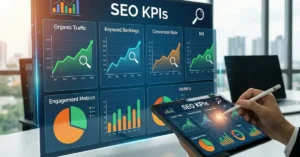
SEO KPIs are measurable indicators that show how effectively your search engine optimisation efforts are improving visibility, traffic, engagement, and business outcomes.
Who Should Track Them?
- Business owners investing in SEO
- Marketing teams and agencies
- Website managers
- E-commerce operators
- Content publishers
How They Work
KPIs track performance across the SEO funnel from visibility to conversions.
Why They Matter
They reveal whether SEO is generating meaningful growth, not just vanity metrics.
Why Tracking the Right SEO KPIs Matters
SEO is a long term investment. Poor measurement leads to:
- Wasted budget
- Misguided strategy
- False expectations
- Missed opportunities
Strong KPIs enable:
- Data-driven decisions
- Clear ROI evaluation
- Prioritisation of high impact actions
- Better alignment with business goals
Core SEO KPIs Every Website Should Track

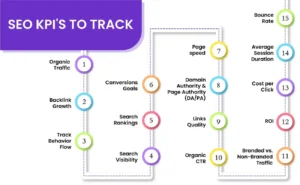
1. Organic Traffic
The number of visitors arriving from search engines.
Measured in tools like Google Analytics.
Why it matters:
Traffic indicates visibility and demand.
But beware: Traffic alone doesn’t equal success.
2. Keyword Rankings
Your position in search results for target queries.
Tools such as Google Search Console provide ranking insights.
Why it matters:
Higher rankings generally bring more visibility.
Limitation: Rankings fluctuate and don’t guarantee clicks.
3. Click Through Rate (CTR)
Percentage of impressions that result in clicks.
High impressions + low CTR = opportunity to improve titles and meta descriptions.
4. Conversions from Organic Traffic
Actions that generate business value:
- Purchases
- Leads
- Sign-ups
- Downloads
- Calls
This is one of the most important KPIs.
Traffic without conversions doesn’t grow your business.
5. Organic Revenue (for E-commerce)
Tracks how much income comes directly from search traffic.
Essential for ROI analysis.
Engagement KPIs That Indicate Content Quality
6. Bounce Rate & Dwell Time
These metrics show whether visitors find your content useful.
- High bounce rate may indicate mismatch with search intent
- Longer time on page usually signals engagement
7. Pages per Session
Indicates whether users explore your site further.
Strong internal linking often improves this metric.
Technical SEO KPIs
Technical health affects whether search engines can crawl and index your site effectively.
8. Index Coverage
How many pages are indexed versus excluded.
Issues here can severely limit visibility.
9. Page Speed & Core Web Vitals
Performance metrics influencing user experience and rankings.
Key factors include:
- Loading speed
- Interactivity
- Visual stability
10. Crawl Errors
Broken links, server issues, and redirect problems reduce SEO effectiveness.
Local SEO KPIs (If Applicable)
For location based businesses, visibility in local results is critical.
11. Local Pack Rankings
Position in map results for local searches.
12. Calls, Directions & Local Actions
These often matter more than website visits.
Emerging SEO KPIs for AI-Driven Search
Search behaviour is evolving rapidly due to AI-generated answers.
Traditional metrics don’t always capture influence in zero-click environments.
LLM Recommendation Presence
Measures how often your brand appears in AI responses from systems like ChatGPT.
Brand Mentions in AI Answers
Even without clicks, being cited can influence decisions.
Visibility in AI Overviews
Search engines increasingly summarise information directly on results pages.
Why These New KPIs Matter
Influence can occur before a user ever visits your site.
Tracking presence not just clicks is becoming essential.
Choosing the Right KPIs for Your Business Goals
Not all metrics matter equally.
For Lead Generation Businesses
Prioritise:
- Conversions
- Qualified traffic
- Cost per lead
- Keyword rankings for buyer-intent terms
For E-commerce
Focus on:
- Organic revenue
- Conversion rate
- Product visibility
- Average order value
For Brand Awareness
Track:
- Traffic growth
- Impressions
- Brand searches
- Mentions
Vanity Metrics vs Actionable KPIs
Vanity Metrics (Misleading Alone)
- Raw traffic numbers
- Total impressions
- Social shares without conversions
Actionable KPIs
- Revenue
- Leads
- Conversion rate
- High-intent keyword performance
How to Set Effective SEO KPIs (Step-by-Step)
Step 1 Define Business Objectives
Examples:
- Increase sales
- Generate leads
- Build brand awareness
- Enter new markets
Step 2 Map KPIs to the Customer Journey
Awareness → Traffic & impressions
Consideration → Engagement metrics
Decision → Conversions & revenue
Step 3 Establish Baselines
Measure current performance before setting targets.
Step 4 Set Realistic Timeframes
SEO improvements often take:
- 3 to 6 months for early impact
- 6 to 12 months for significant growth
Common KPI Mistakes to Avoid
- Tracking too many metrics
- Ignoring business outcomes
- Changing goals too frequently
- Expecting quick results
- Not segmenting data
Future of SEO Measurement
SEO is shifting from ranking-focused to visibility-focused.
Key trends include:
- Zero-click search growth
- AI-generated answers
- Brand authority signals
- Multi-platform discovery
Businesses that adapt their KPIs accordingly will gain a competitive advantage.
Are SEO KPIs Worth Tracking?
Absolutely but only if they align with real business goals.
Tracking the wrong metrics can be worse than tracking none at all.
Focus on outcomes, not just activity.
FAQ
Q1. How long does it take to see improvements in SEO KPIs?
A. Most websites see measurable changes within 3 to 6 months, though competitive industries may take longer.
Q2. What is the most important SEO KPI?
A. Conversions or revenue from organic traffic typically matter most.
Q3. Are rankings still important?
A. Yes, but they should be evaluated alongside traffic and business impact.
Q4. Do small businesses need complex KPI tracking?
A. Not necessarily. A focused set of metrics is often more effective.
Q5. Can SEO KPIs predict ROI?
A. They indicate performance trends but cannot guarantee future results.


